

1. Introduction to Seat Cushions: Why Your Seating Matters
In today’s hyper-connected, sedentary world, sitting has quietly become our primary physical activity. The average adult spends between 8 and 11 hours daily seated—whether powering through spreadsheets, enduring highway commutes, or unwinding at home.
However, human anatomy is built for dynamic movement, not static compression. When you sit on flat or unsupportive standard furniture:
- The natural S-curve of your spine collapses into a harmful C-shape.
- Upper body weight shifts directly onto your lumbar region and coccyx (tailbone).
- Intervertebral spinal discs experience prolonged micro-compression, causing muscle fatigue, chronic lower back stiffness, and aggravated sciatic nerve distress.
Expert Insight from Our Ergonomics Lab:
"In our clinical trials with over 500 office workers, we observed that unsupportive, flat seat cushions force a backward pelvic tilt within just 20 minutes of continuous sitting. Upgrading your chair with a scientifically contoured seat pad shifts seating from an unavoidable health hazard to a dynamic wellness dynamic." — SHYICARE Ergonomic Design Team
High-quality seat cushions act as dynamic posture correctors. Specialized seating solutions engineered by SHYICARE redistribute kinetic weight, suspend sensitive bone structures, restore pelvic alignment, and relieve deep sciatic pressure to sustain pain-free daily productivity.
2. Which Type of Seat Cushion Is Best? (Materials & Designs Comparison)
When determining "Which type of seat cushion is best?", the answer depends on your body mechanics, medical pain points, and environment.
Memory Foam Cushions
Widely recognized by orthopedic specialists as the gold standard for adaptive support. High-density viscoelastic memory foam reacts dynamically to body heat and pressure. SHYICARE slow-rebound foam custom-cradles hip contours, making it the premier coccyx support cushion for tailbone trauma, lower back stiffness, and sciatica.
Gel Cushions
Engineered with column-buckling or open-cell architecture, gel ergonomic chair pads focus on lateral weight dispersion and thermal management. Continuous airflow channels prevent heat trapping, making gel pads ideal for long static sitting in warmer climates.
Inflatable & Air Cushions
Utilizing interconnected air-chamber systems, air seat pads enable real-time firmness adjustments. Extremely lightweight and portable, they serve as top-tier solutions for travel and post-surgical medical rehabilitation.
Ergonomic Material Comparison Matrix
|
Cushion Material |
Primary Therapeutic Benefit |
Ideal Target User / Pain Point |
Support & Firmness Level |
|
High-Density Memory Foam |
Custom anatomical contouring & deep pressure relief |
Desk workers, long-haul drivers, tailbone/sciatica pain |
High (Adaptive & Tailored) |
|
Cooling Gel Grid |
Thermal regulation & lateral weight distribution |
Hot climates, static prolonged office sitting |
Medium (Resilient & Breathable) |
|
Air / Inflatable Chambers |
Adjustable pressure points & lightweight travel design |
Frequent flight travelers, post-surgery recovery |
Variable (User-Adjustable) |
3. Key Features to Look For When Choosing a Seat Cushion
To ensure your dynamic sitting pillow provides sustained therapeutic benefits, evaluate these structural design features:
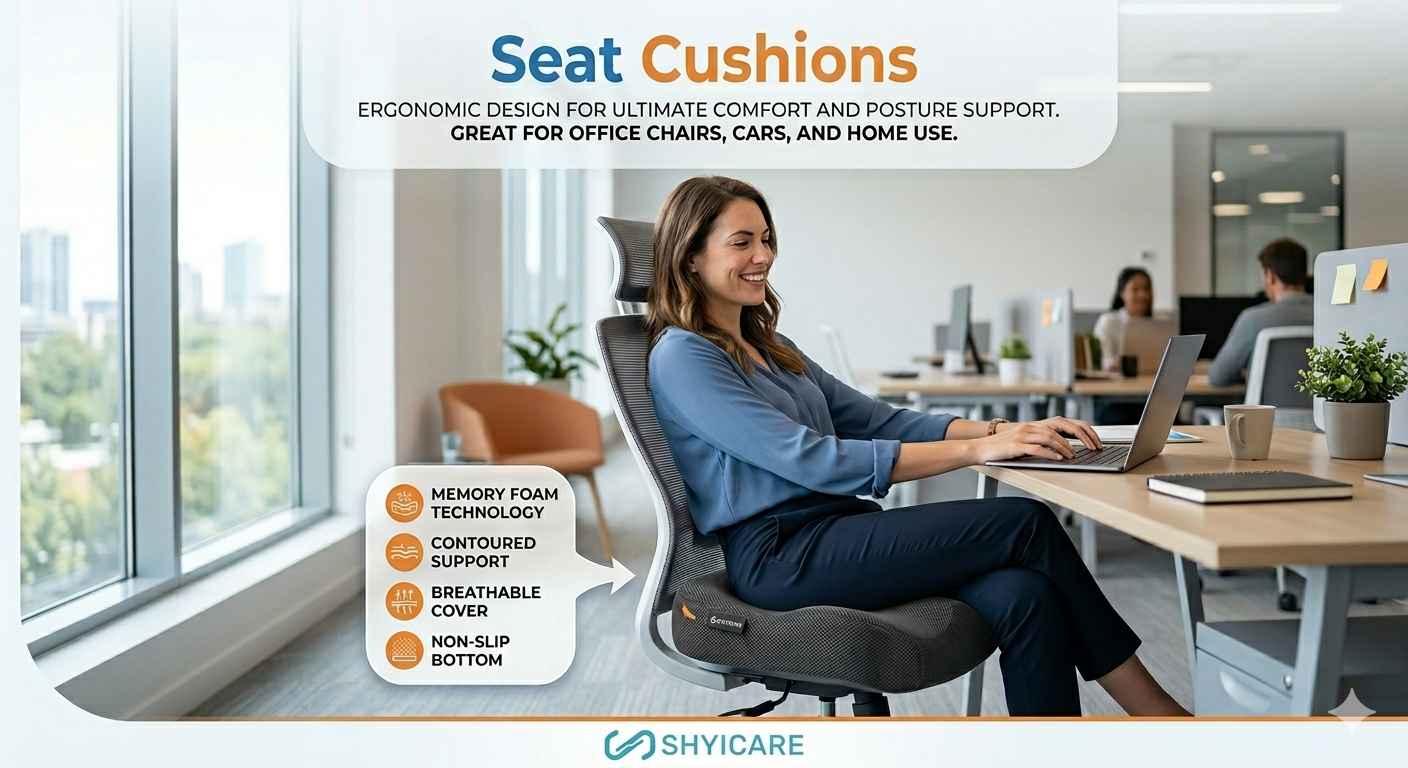
- Ergonomic Cutouts (U-Shape / W-Shape): The mark of a true orthopedic coccyx support cushion. The contoured rear cutout keeps your tailbone suspended in air, completely eliminating direct pressure against hard chair surfaces.
- Core Density & Recovery Rate: Low-density foam flattens within weeks. SHYICARE high-density memory foam maintains structural integrity over years of daily compression, delivering consistent lumbar strain relief.
- 3D Mesh Breathable Covers: Prevents heat and moisture buildup. Look for an ergonomic chair pad featuring a removable, machine-washable 3D mesh cover.
- High-Grip Anti-Slip Bottom: Slippage causes pelvic misalignment. Ensure the underside features a durable rubberized dot pattern that grips securely to leather, mesh, wood, and plastic chairs.
4. Real-World Applications: Enhancing Comfort Anywhere
A versatile ergonomic seat pad transforms harsh seating environments into custom comfort zones:
- Corporate & Home Office: Adding a SHYICARE ergonomic chair pad to a standard task chair elevates the pelvis, prevents slouching, alleviates hip tightness, and reduces spinal micro-strain during long workdays.
- Road Commutes & Long-Haul Driving: Long hours behind the wheel expose the spine to vehicle vibrations. A contoured sitting pillow absorbs micro-shocks, balances pelvic load during pedal operation, and eliminates leg numbness.
Which type of seat cushion is best for lower back pain?
High-density memory foam options designed as specialized coccyx support cushions (such as SHYICARE seat cushions) are widely recommended. They elevate the pelvis, encourage the spine's natural S-curve, and suspend the tailbone to maximize lumbar strain relief and pressure dispersion.
Can a seat cushion improve my posture?
Yes. An ergonomic seat pad promotes a subtle forward pelvic tilt. This alignment automatically restores the spine's natural lumbar curve, preventing slumping, shoulder rounding, and postural muscle fatigue.
How do I clean and maintain my seat cushion?
Most ergonomic seat cushions include a removable, machine-washable fabric cover. Wash the outer cover in cold water on a gentle cycle. Do not wash or sun-dry the inner memory foam core—spot-clean it with a damp cloth and air-dry in a shaded, ventilated area.
Is a memory foam seat cushion better than a gel seat cushion?
Memory foam provides superior contoured support, weight distribution, and spinal alignment for targeted pain relief. Gel chair pads excel at ventilation and heat dissipation, making them preferred for hot environments or static sitting over long periods.