

1. Introduction: The Evolution of Patient Positioning Solutions
Proper surgical patient positioning is a critical aspect of perioperative care that directly impacts clinical outcomes and surgical access. Historically, operating room teams faced a difficult compromise between tissue protection and physical usability.
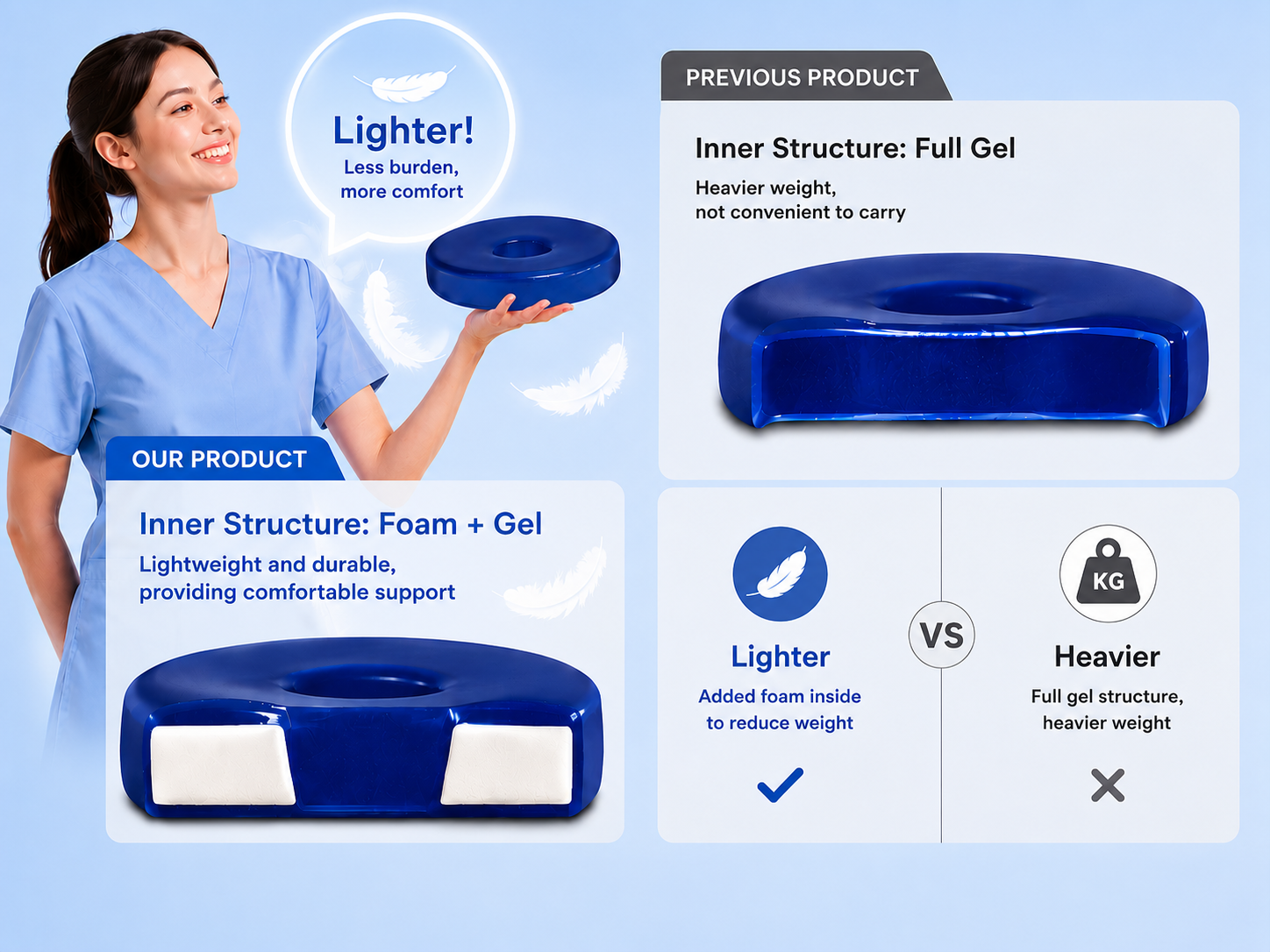
Traditional solid gel support tools—composed entirely of dense polymer materials—offer good pressure redistribution. However, their extreme weight creates real operational challenges. A standard solid gel chest roll or head positioner can weigh anywhere from 6 to 12 kilograms (13 to 26 lbs). Over a full surgical schedule, moving and adjusting these heavy items causes physical strain and burnout for perioperative nurses and technicians.
Conversely, single-use polyurethane foam devices are light and easy to handle. However, under high contact pressures, basic foam often compresses completely—a phenomenon known as "bottoming out." When a patient's bony prominences push through compressed foam to contact the hard operating table, microvascular blood flow slows, dramatically increasing the risk of intraoperative tissue damage and pressure injuries (AORN Guideline compliant).
To solve this dilemma, SHYICARE developed the Lightweight Gel Positioning Pad. By combining advanced polymer chemistry with ergonomic structural design, SHYICARE offers composite gel-foam support pads that safeguard patient tissue while easing the physical workload for surgical staff.
Composite Structure Overview
· TPU Outer Protective Membrane: Medical-grade, fluid-resistant, and seam-free barrier.
· Viscoelastic Polymer Gel Layer: Directly redistributes peak tissue pressure and minimizes shear forces.
· High-Density Ergonomic Foam Core: Reduces pad weight by 30%–50% while preventing bottoming out under heavy loads.
2. Core Advantages: Performance Meets Ergonomic Design
Choosing the SHYICARE Lightweight Gel Positioning Pad brings a targeted composite structure into the operating suite—engineered specifically as high-performance ergonomic operating room equipment:
· Viscoelastic Polymer Gel Layer: Placed directly beneath the top surface, this gel layer mimics human soft tissue. It responds to body heat and weight, conforming to body contours. Rather than concentrating weight on narrow points, it spreads pressure across a larger surface area while absorbing lateral shear forces when patients are tilted.
· High-Density Ergonomic Foam Core: The internal core uses high-resilience, high-density foam that cuts overall pad weight by 30% to 50% compared to solid gel equivalents. This structural foundation maintains shape under heavy loads, preventing the pad from bottoming out even during extended surgical procedures.
· Medical-Grade TPU Outer Membrane: The entire pad is sealed in a continuous Thermoplastic Polyurethane (TPU) skin. Unlike traditional PVC coatings that can stiffen, crack, or release plasticizers over time, TPU remains flexible, tear-resistant, biocompatible, and completely fluid-proof.
|
Material Component |
Primary Clinical & Operational Benefit |
|
Medical-Grade Gel Layer |
Redistributes peak pressure; minimizes lateral shear forces. |
|
High-Density Foam Core |
Cuts overall weight by 30%–50%; prevents structural bottoming out. |
|
Protective TPU Shell |
Fluid-resistant barrier; withstands hospital-grade disinfectants. |
By balancing these three materials, SHYICARE addresses both patient safety and medical staff health. Surgical teams get lightweight surgical gel positioners that are easy to maneuver during room turnover, while patients receive stable, reliable pressure relief throughout surgery.
3. Clinical Applications & Versatility in the Operating Room
Complex surgical procedures require tailored positioning strategies. SHYICARE Lightweight Gel Positioning Pads provide reliable intraoperative pressure injury prevention across various surgical alignments:
· Prone Positioning in Spine Surgery: In lengthy posterior lumbar spinal fusions lasting over four hours, prone positioning places high pressure on the forehead, chin, chest, and iliac crests. SHYICARE prone headrests and chest rolls distribute this weight evenly, protecting delicate facial nerves and capillary beds from pressure damage.
· Lateral Decubitus in Total Hip Arthroplasty: During hip replacements, patients lie on their side, placing concentrated force on the downside trochanter and lateral malleolus. SHYICARE lateral positioners cushion these bony prominences, helping prevent tissue ischemia and nerve compression.
· Lithotomy & Supine Alignments: In robotic gynecological or urological procedures requiring steep Trendelenburg (head-down) angles, SHYICARE flat pads and armboard overlays keep the patient stable, preventing sliding without causing pressure hot spots.
· Infection Control & Imaging Compatibility: The seamless TPU enclosure forms an absolute barrier against blood, saline, and bodily fluids. Between cases, perioperative staff can clean the non-porous surface using standard hospital-grade disinfectants (such as quaternary ammonium or hydrogen peroxide wipes). Additionally, the entire composite assembly is fully radiolucent, ensuring clear visual fields during C-arm fluoroscopy and intraoperative X-rays.
4. Future Outlook & Making the Smart Upgrade
Upgrading surgical equipment involves balancing immediate clinical needs against total cost of ownership. SHYICARE lightweight surgical gel positioners offer a practical long-term choice for healthcare managers:
· Reduced Staff Injuries & Turnover Costs: Occupational back pain and strain injuries among perioperative nurses frequently stem from lifting heavy equipment. Integrating lightweight gel positioning pads reduces lifting strain, supporting workplace safety and lowering injury-related expenses.
· Waste Reduction & Sustainability: Disposable foam positioners generate large volumes of biohazardous waste after a single use. SHYICARE reusable composite gel-foam support pads withstand thousands of surgical cycles without losing shape, directly supporting hospital sustainability targets.
· Optimized Procurement Value: Manufactured under strict quality management standards (ISO 13485 compliant), SHYICARE delivers strong clinical performance for intraoperative pressure injury prevention at a highly competitive cost point.
What makes the Lightweight Gel Positioning Pad different from standard solid gel pads?
Standard gel pads use 100% solid viscoelastic gel, making them heavy and prone to sagging over time. SHYICARE pads use a Gel + Foam + TPU composite design. The high-density foam core reduces total weight by up to 50%, while the gel top layer maintains pressure redistribution. This makes setup and patient positioning significantly easier for perioperative personnel.
Is the TPU outer membrane latex-free and safe for sensitive skin?
Yes. The outer TPU membrane is 100% latex-free, non-allergenic, and biocompatible. It prevents direct contact with raw polymers, making it safe for patients with sensitive skin or latex allergies.
How do these composite gel-foam support pads help prevent pressure ulcers during long surgeries?
Intraoperative pressure injuries occur when continuous downward pressure cuts off capillary blood supply to tissue over bony prominences. These pads combine a fluid viscoelastic gel surface—which molds to body shapes and reduces shear forces—with a high-density foam core that prevents bottoming out, maintaining microvascular circulation during multi-hour surgical procedures.
Are lightweight gel positioning pads easy to clean and disinfect between cases?
Yes. The outer layer is built from seamless, medical-grade TPU, creating a fluid-proof barrier against blood and pathogens. The surface can be wiped down quickly with standard hospital disinfectants (such as quaternary ammonium or hydrogen peroxide wipes) between operating room turnovers.