

Every journey begins with a single step, but the quality of that step determines your long-term mobility and comfort. While footwear design often emphasizes external aesthetics, the true engine of foot stability sits hidden inside the shoe: the insole.
Whether you are an athlete striving for peak performance, a nurse enduring 12-hour standing shifts, or someone seeking relief from chronic heel pain, understanding how to select the right shoe inserts can dramatically improve your posture, energy levels, and overall health. At SHYICARE, our team collaborates with biomechanical researchers to engineer advanced footbeds designed to transform ordinary shoes into tailored support systems.
1. Why Foot Support & Arch Support Matter
Insoles—often referred to as shoe inserts, inner soles, or orthotics—are removable footbeds designed to fit inside footwear. Beyond offering a layer of softness, their primary physiological function is to stabilize the foot, realign the skeleton, and distribute pressure evenly. The human foot is a complex structure consisting of 26 bones, 33 joints, and over 100 muscles and tendons. When walking on hard, modern surfaces, feet absorb heavy ground reaction forces—making high-performance shock absorption essential for healthy movement.
Without adequate internal support, these repetitive shockwaves propagate up the body's Kinetic Chain, frequently resulting in chronic lower back strain and hip pain. According to biomechanical studies, common foot ailments typically stem from structural imbalances:
· Flat Feet (Overpronation): The foot's medial longitudinal arch collapses flat against the ground. Integrating structured arch support helps prevent inner ankle aches and muscle fatigue.
· High Arches (Underpronation/Supination): The rigid arch fails to cushion impact properly. High-cushioning shoe inserts help fill the anatomical void and absorb ground forces.
· Plantar Fasciitis: Micro-tears occur in the plantar fascia tissue band, causing severe stabbing heel pain. Targeted orthotic footbeds relieve pressure to manage plantar fasciitis discomfort effectively.
· Metatarsalgia: Severe burning or aching sensations behind the toes, common among professionals who wear flat shoes daily.
Integrating ergonomically contoured SHYICARE insoles helps bridge the anatomical gap between flat footwear and your feet, protecting your joints from daily micro-trauma.
2. Step-by-Step Guide: How Should I Choose the Best Insoles?
Selecting the correct pair requires evaluating your arch morphology, daily activity demands, core materials, and shoe construction.
Step 1: Identify Your Arch Profile
To determine your arch type at home, perform the "Wet Paper Test":
· Low Arch / Flat Foot: You require firm arch support to stabilize the foot and prevent overpronation.
· Neutral Arch: Flexible, medium-density contoured footbeds work best to preserve natural foot motion.
· High Arch: You need high-cushioning shoe inserts with elevated arch bridges to fill the void and maximize shock absorption.
Step 2: Match Insole Features to Your Daily Activities
· Work & Standing Long Hours: Choose dense EVA foam or gel-infused shoe inserts engineered for maximum shock absorption during long standing shifts.
· High-Impact Athletics: Runners need athletic footbeds with high energy-return properties to protect the knees during rapid direction changes.
· Pain Management & Rehabilitation: Individuals managing medical conditions like plantar fasciitis need rigid heel cups and dynamic arch support to soothe inflamed tissues.
Step 3: Evaluate Materials and Construction
· Medical-Grade Gel: Best for targeted pressure point cushioning and maximum shock absorption.
· EVA Foam (Ethylene-Vinyl Acetate): Lightweight shoe inserts offering structural longevity and energy return.
· Polyurethane (PU) Foam: Durable footbeds ideal for heavy-duty work boots.
Step 4: Ensure Correct Shoe Fit and Volume
Full-length shoe inserts replace factory liners completely, whereas 3/4-length options slide easily into low-profile shoes without crowding the toe box.
3. Core Features & Advanced Technologies in SHYICARE Insoles
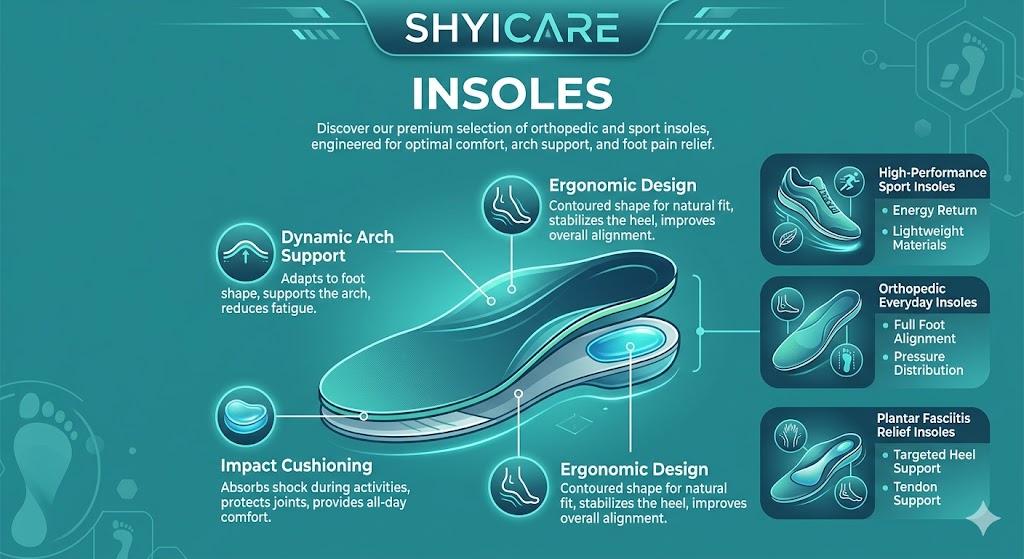
Modern orthotic technology has evolved far beyond basic foam padding. SHYICARE combines biomechanical principles with advanced materials science to create high-performance footbeds tailored to specialized needs.
|
Insole Category |
Core Technology & Features |
Key Biomechanical Benefit |
Real-World Application |
|
Orthopedic & Everyday |
Anatomical Arch Support & Full-Foot Pressure Mapping |
Evenly distributes body weight; prevents arch collapse and aligns posture. |
Essential for teachers, police officers, and retail staff walking on hard floors daily. |
|
High-Performance Sport |
Dual-Density Cushioning & High Shock Absorption |
Absorbs up to 40% of ground impact; propels stride forward while protecting knees. |
Ideal for marathon runners and athletes seeking peak physical endurance. |
|
Plantar Fasciitis Relief |
Deep Ergonomic Heel Cradle & Targeted Gel Inserts |
Locks the hindfoot in place, relieves plantar fasciitis pain, and stabilizes heels. |
Designed for individuals suffering from severe morning heel pain or heel spurs. |
Every SHYICARE insole features an anti-microbial, moisture-wicking top cloth to keep your feet fresh and dry throughout long workdays.
4. Real Wearer Experience & Long-Term Health Benefits
Key Health Benefits:
· Preventive Joint Protection: Delivering superior shock absorption at the foot level shields fragile cartilage in the knees and lower spine.
· Improved Energy Conservation: Ergonomic arch support reduces muscle strain in the calves and hamstrings.
· Condition Relief: Specialized orthotic footbeds alleviate stress associated with plantar fasciitis and arch strain.
5. Maintenance & Frequently Asked Questions (FAQ)
Maintenance & Replacement Best Practices
· Cleaning: Hand-wash shoe inserts with lukewarm water and mild soap. Never machine-wash them.
· Drying: Allow footbeds to air-dry completely away from direct heat sources.
· Air Out: Remove insoles from your shoes overnight to let trapped moisture evaporate.
· Replacement Timeline: Replace your shoe inserts every 6 to 12 months or when signs of wear appear.
How do I know if I need arch support insoles?
If you regularly experience sore feet, knee discomfort, or lower back pain after standing, your feet likely require structured arch support and enhanced shock absorption.
How should I choose the right insoles for my daily shoes?
Identify your arch type, evaluate your primary daily activities, and select SHYICARE shoe inserts tailored to your specific cushioning or condition-relief needs like plantar fasciitis management.
Do I need to remove my shoe's existing factory liners?
Yes. For full-length replacement footbeds, always remove the original factory insoles first to prevent overcrowding your shoes.
How long do SHYICARE insoles typically last?
Under regular daily wear, SHYICARE footbeds maintain optimal structural support for 6 to 12 months.