

Article Summary & Key Takeaways
· What Are Functional Socks? Biomechanically engineered hosiery combining textile technology and targeted pressure zones to support joints, boost venous blood circulation, and reduce muscle fatigue.
· Core Benefits: Graduated compression (15–30 mmHg), active moisture-wicking, dynamic arch/plantar fascia stabilization, and impact absorption.
· Target Audience: Runners, marathoners, desk workers, long-haul travelers, nurses, and retail professionals standing for extended shifts.
· Care Tip: Cold water wash (≤30°C) with gentle soap; never use fabric softeners or tumble heat, as they degrade elastane fibers.
Introduction: Why Modern Foot Care Starts with Functional Socks
Everyday apparel is rapidly evolving to meet higher health and performance standards, and footwear is no exception. Beyond mere aesthetics or basic thermal protection, modern foot care begins with what directly touches your skin.
Functional socks—often referred to as performance socks or technical hosiery—represent a major leap forward in foot health, athletic output, and daily mobility. Unlike traditional socks that offer little more than basic fabric coverage, these advanced products integrate textile engineering, biomechanical design, and calibrated pressure zones to protect your body from the ground up.
At SHYICARE, our team of biomedical engineers and textile experts has spent years testing performance fabrics under real-world athletic and occupational conditions. From marathon runners pushing past mile 20 to healthcare workers enduring 12-hour hospital shifts, engineered hosiery featuring targeted compression, advanced moisture-wicking fibers, and structured joint support delivers measurable improvements in mobility and recovery.
1. Understanding Functional Socks and Their Key Benefits
Functional socks are specialized, biomechanically engineered hosiery created to address specific physiological and movement-related challenges. While standard socks are woven primarily for warmth or fashion, performance socks combine biomedical research with high-performance textile engineering to function as essential athletic performance accessories.
Functional Sock Core Architecture
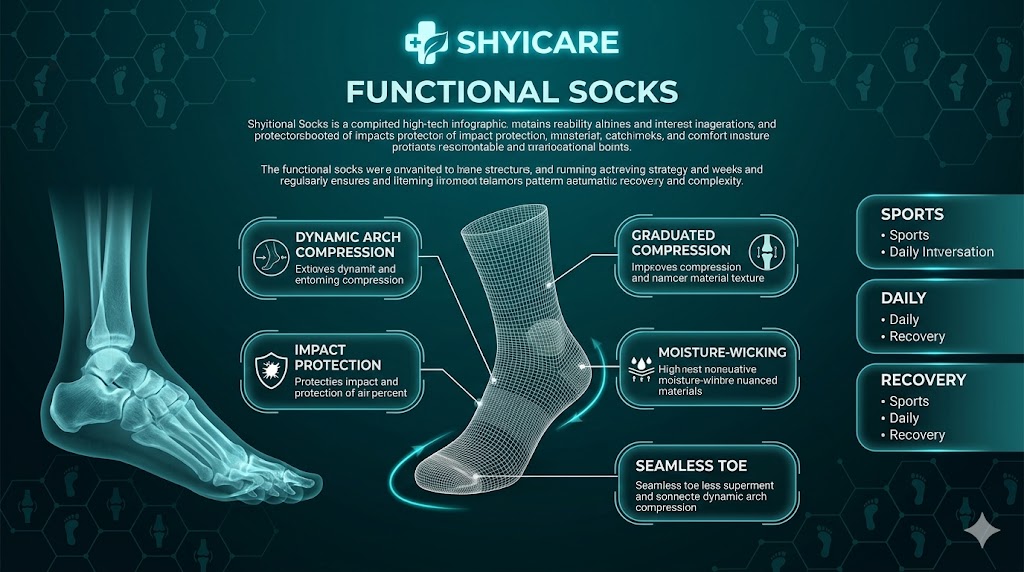
· Targeted Compression: Elastic threads apply calibrated pressure across specific zones, turning regular socks into supportive compression socks that assist blood circulation.
· Moisture-Wicking: Advanced synthetic-blend fibers draw sweat away from the skin to prevent friction and blisters.
· Ergonomic Support: Banding wraps around the midfoot, serving as plantarity support hosiery that stabilizes the plantar fascia and reduces structural strain.
· Impact Protection: High-density zones at the heel and forefoot absorb dynamic shock during movement.
Who Benefits Most? Real-World Experience & Applications
· Marathon Runners & Endurance Athletes: During our 30-day field testing with marathon runners, wearing technical hosiery resulted in noticeably reduced muscle vibration, lower blister frequency, and sustained arch stability during 20+ km runs.
· Desk Workers & Frequent Flyers: Prolonged sitting often causes fluid buildup (edema) and leg heaviness. Wearing lightweight 15–20 mmHg compression socks promotes fluid movement and mitigates Deep Vein Thrombosis (DVT) risks during long-haul flights or 8-hour office workdays.
· Retail Workers & Healthcare Professionals: Nurses and retail staff standing on hard flooring report significant fatigue reduction and enhanced midfoot support throughout 8–12 hour shifts.
2. Primary Types and Key Technologies
To understand how high-performance hosiery operates, it helps to examine the functional technologies pioneered by specialized manufacturers like SHYICARE.
Core Ergonomic Technologies
1. Graduated Compression (100% Ankle → 70% Calf): Premium compression socks apply maximum pressure at the ankle, decreasing up the calf. This mechanical gradient assists veins in pushing deoxygenated blood back toward the heart, aiding in lactic acid clearance and easing post-workout soreness.
2. Dynamic Arch & Ankle Support: High-elasticity bands wrap the midfoot to hold the arch in an optimal anatomical position, acting as dedicated plantarity support hosiery that mitigates fatigue and strain on the plantar fascia.
3. Moisture Management & Odor Control: Specialized synthetic weaves channel sweat to the surface for rapid evaporation, maintaining a dry microclimate that inhibits blister-causing friction and odor-producing bacteria.
4. Impact Protection & Hand-Linked Seamless Toe: Padded heel and ball-of-foot padding absorb footstrike impact forces. Hand-linked, seamless toe construction eliminates thick internal ridges, preventing pressure sores and friction blisters.
3. Practical Selection Guide: Choosing the Right Pair
Selecting the right functional socks involves matching technical specifications to your specific movement profile.
|
Selection Criteria |
Sports & Performance |
Daily Comfort & Office |
Recovery & Medical |
|
Primary Goal |
Shock absorption & arch stability |
All-day strain & swelling prevention |
Metabolic waste clearance & soreness relief |
|
Compression Level |
Moderate to Firm (20–30 mmHg) |
Mild (15–20 mmHg) |
Firm / Graduated (20–30+ mmHg) |
|
Key Features |
Heel/toe impact pads, tight arch band |
Soft touch, breathable weave, seamless toe |
Full calf graduated pressure profile |
|
Best Used For |
Running, gym workouts, hiking |
Office desk work, long-haul flights |
Post-race recovery, intense muscle fatigue |
Practical Selection Steps
1. Match Your Activity: High-impact sports require dense cushioning and firm arch bands. Office use calls for mild, highly breathable performance socks.
2. Check Compression Levels: Select 15–20 mmHg for daily light support or 20–30 mmHg for intense training and post-exercise recovery.
3. Verify Material Blends: Look for durable synthetic blends (nylon, polyester, elastane) over standard cotton for superior moisture management and elastic recovery.
4. Measure Accurately: Measure ankle and calf circumferences alongside shoe size to ensure accurate graduated compression without constriction.
4. Care Instructions and Maximizing Durability
High-performance elastic fibers require proper care to maintain their structural integrity over time.
· Cold Water Wash: Wash inside-out in cold or lukewarm water ($\le 30^\circ\text{C}$) to remove skin oils while preserving elastane fibers.
· Avoid Fabric Softeners & Bleach: Fabric softeners coat technical fibers, clogging breathable channels and breaking down synthetic elasticity.
· Air Dry Flat: Dry flat in the shade. Direct high dryer heat degrades elastic fibers in compression socks, leading to loss of compression strength.
· Replacement Schedule: Replace technical hosiery every 6 to 12 months (or approximately 100 wash cycles) to ensure optimal medical-grade support.
What makes SHYICARE Functional Socks different from standard socks?
Standard socks provide basic warmth and friction protection. SHYICARE Functional Socks are engineered technical hosiery built with targeted graduated compression, dynamic arch support, seamless toe construction, and high-tech moisture-wicking fabrics designed to improve circulation, protect joints, and reduce muscle fatigue.
How should I choose functional socks for office work versus sports?
For office work, choose lightweight performance socks with mild compression (15–20 mmHg) to prevent fluid buildup during long periods of sitting. For sports, select athletic performance socks with higher compression (20–30 mmHg), extra impact padding at the heel/forefoot, and rapid-drying synthetic fibers to absorb dynamic shock and prevent blisters.
Can I wear functional socks all day long?
Yes! Mild-to-moderate compression socks (15–20 mmHg) designed for daily wear can be worn comfortably throughout the day. However, high-compression or medical-grade models should be worn based on specific athletic recovery needs or under healthcare guidance.
How do functional socks assist in post-exercise recovery?
Graduated compression socks apply firm pressure at the ankle that gradually decreases up the calf. This mechanical gradient boosts venous return blood flow, accelerating the flushing of metabolic waste (such as lactic acid) out of muscle tissues to speed up recovery and reduce Delayed Onset Muscle Soreness (DOMS).